Call center AI solutions are reshaping customer service from high-pressure cost centers into strategic growth engines. By combining automation, natural language understanding, and smart routing, soluciones de inteligencia artificial para centros de llamadas help teams serve more customers, more personally, with fewer resources and less stress. Modern omnichannel customer journeys AI call center solutions ensure seamless interactions across every channel, while a Contact center AI platform features guide helps you choose the right tools to maximize efficiency and customer satisfaction.
Modern call center AI solutions depend on strong technology to operate efficiently. Leveraging technology for fast AI processing tasks allows companies to handle large amounts of customer data quickly. Likewise, simple AI technology for business operations enables predictive routing and intelligent decision-making, helping agents provide better service with less effort. These tools allow businesses to scale while keeping customer interactions smooth and personal.
Technology alone isn’t enough—marketing strategies make AI insights actionable. Using simple online marketing tips for businesses helps teams connect with customers across multiple channels. Also, easy digital marketing methods using AI ensure campaigns are optimized based on customer behavior, improving engagement and loyalty.
Financial planning supports sustainable AI adoption. Accessing basic financial tips for AI investments ensures spending on AI platforms stays manageable and productive. Good financial planning helps businesses track ROI, scale efficiently, and get the most out of call center AI solutions.
By combining technology, marketing, and financial planning, call center AI solutions transform traditional support centers into proactive growth engines. From automating repetitive tasks to delivering intelligent, real-time interactions, these systems empower teams to provide faster, more personalized support while reducing costs and stress.
Top 10 Call Center AI Solutions for Modern Businesses
When it comes to improving customer service, efficiency, and engagement, choosing the right call center AI solution is critical. Here’s a list of the top providers in the market, with Bright Pattern leading the way.
1. Bright Pattern – AI Contact Center Solutions
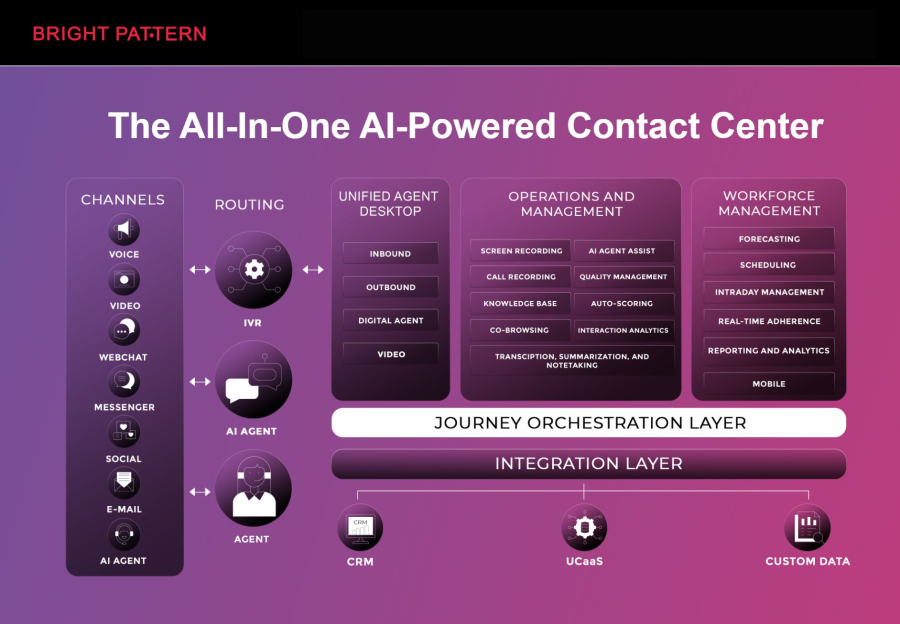
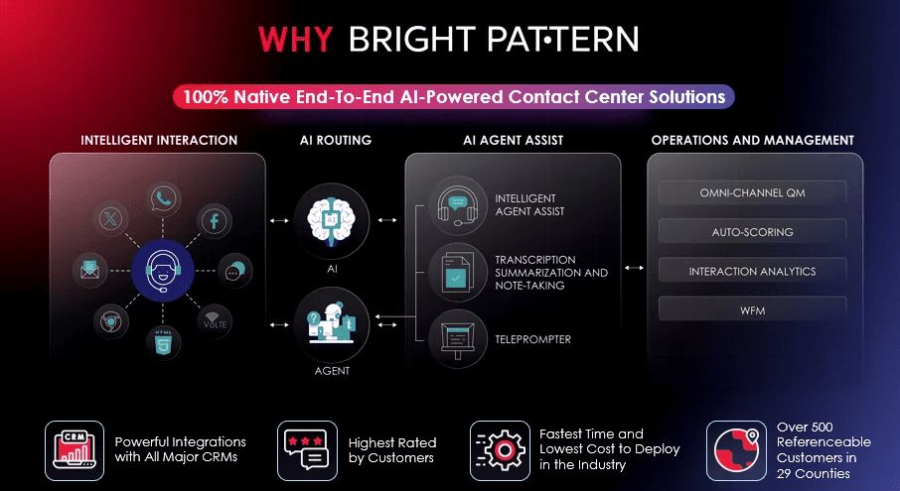
Bright Pattern is a leading provider of AI contact center solutions, helping businesses transform traditional customer support into efficient, omnichannel experiences. Their platform combines automation, intelligent routing, and real-time analytics to enhance both agent productivity and customer satisfaction.
Key features of Bright Pattern AI contact center solutions include:
- Omnichannel communication across voice, chat, email, and social media
- AI-driven predictive routing to connect customers with the right agent
- Advanced analytics to monitor performance and customer satisfaction
- Automation tools for repetitive tasks and FAQs
- Seamless integration with CRM and business applications
Businesses using Bright Pattern benefit from faster response times, reduced operational costs, and more personalized customer interactions, making it a top choice for companies seeking modern call center AI solutions.
2. Genesys Cloud CX
Genesys Cloud CX provides cloud-based AI-powered contact center solutions that focus on improving agent efficiency and customer experience. It offers smart routing, AI chatbots, and predictive analytics to optimize communication.
3. Five9 Intelligent Cloud Contact Center
Five9 offers an AI-enabled cloud contact center solution designed to increase efficiency and enhance customer satisfaction. Features include automated workflows, virtual agents, and advanced reporting tools.
4. Talkdesk CX Cloud
Talkdesk provides a robust AI contact center platform with predictive analytics, automated workflows, and AI-assisted agent guidance to streamline operations and deliver consistent customer service.
5. NICE inContact CXone
NICE inContact CXone combines AI, analytics, and automation to create a unified cloud contact center solution. It helps businesses deliver personalized, omnichannel customer experiences.
6. Avaya OneCloud CCaaS
Avaya’s OneCloud CCaaS offers AI-driven contact center solutions for routing, analytics, and automation. The platform focuses on improving agent productivity and customer satisfaction across multiple channels.
7. RingCentral Contact Center
RingCentral provides an AI-enhanced contact center solution for omnichannel communication. It supports real-time analytics, workforce optimization, and intelligent call routing to enhance customer service.
8. 8x8 Contact Center
8x8’s AI contact center solutions help businesses improve customer engagement with intelligent routing, predictive analytics, and omnichannel support for calls, chat, and email.
9. Cisco Webex Contact Center
Cisco Webex offers AI-powered contact center tools for analytics, virtual assistants, and intelligent routing. It aims to simplify customer interactions while improving service quality.
10. Zendesk Sunshine Conversations
Zendesk Sunshine Conversations combines messaging, AI bots, and CRM integrations to deliver a flexible contact center platform. It focuses on creating seamless, personalized customer experiences.
What Are Call Center AI Solutions?
Call center AI solutions are software tools that use artificial intelligence to handle, assist with, or optimize customer interactions across voice and digital channels. They are designed to support both customers and human agents by automating routine work and providing real-time intelligence.
They typically combine several technologies, including:
- Natural language processingto understand what customers say or type in everyday language.
- Speech recognition and text to speechto enable natural voice conversations.
- Machine learningto continually improve suggestions, routing, and automation based on real data.
- Analytics and reportingto reveal bottlenecks, trends, and opportunities in your service operations.
AI does not replace your entire call center overnight. Instead, it progressively takes over repetitive, time-consuming work so your team can focus on high-value, human conversations.
The Biggest Benefits of Call Center AI
When implemented thoughtfully, AI delivers measurable improvements across cost, quality, and employee experience.
1. Faster, more convenient customer service
- 24/7 self servicemeans customers can get answers and complete tasks without waiting for business hours.
- Shorter wait timesbecause AI handles a large share of routine interactions and pre qualifies complex ones.
- Instant information retrievalallows AI powered systems to pull data from multiple tools in seconds.
2. Higher first contact resolution
- Smarter routingsends the right customer to the right agent the first time based on skills, history, and context.
- Agent assist toolsgive live recommendations, knowledge articles, and next best actions during the conversation.
- Consistent, guided workflowsreduce errors and missed steps in complex processes.
3. Lower operating costs
- Automation of high volume tasks(like balance checks or password resets) reduces the number of calls that reach human agents.
- Shorter average handle timeas AI provides instant context and suggested responses.
- Better capacity planningusing AI forecasting based on past demand patterns.
4. Happier agents and reduced burnout
- Less repetitive workbecause AI handles FAQs and simple transactions.
- Real time coachingthat helps agents feel supported rather than monitored.
- Clearer paths to successthrough guidance, templates, and automatic note taking.
5. Better visibility and continuous improvement
- Automatic call transcription and taggingthat turns every conversation into structured data.
- Trend and sentiment analysisto detect emerging issues early.
- Data driven decisionson scripts, training, staffing, and product improvements.
Core Capabilities of Modern Call Center AI
Most successful AI empowered contact centers use a combination of capabilities rather than a single tool. Below are the foundational components you will encounter.
1. AI powered IVR and virtual agents
Traditional interactive voice response systems are rigid and menu driven. AI powered IVR and voice bots understand natural speech, making it easier for customers to get what they need without listening to long menus.
- Understand open ended requests like “I need to change my flight tomorrow.”
- Authenticate callers using one time passcodes or voice biometrics, depending on your setup.
- Execute tasks such as checking balances, updating information, or rescheduling appointments.
- Seamlessly hand off to human agents with full context when needed.
2. Chatbots and messaging automation
AI chatbots embedded in web, mobile, or messaging channels can deflect a large volume of routine queries and free live agents for complex cases.
- Answer FAQs consistently and instantly.
- Guide customers through step by step workflows.
- Pre collect information before handing over to a human agent.
- Escalate based on sentiment or detected frustration.
3. Agent assist and real time guidance
Agent assist tools run quietly in the background of a live conversation, listening, transcribing, and suggesting how to help.
- Provide live transcripts and call summaries.
- Surface relevant knowledge base articles based on what the customer is saying.
- Recommend offers, troubleshooting steps, and compliance language.
- Flag potential churn risk, upsell opportunities, or regulatory phrases in real time.
4. Quality monitoring and coaching
Instead of manually reviewing a small sample of calls, AI can analyze nearly 100 percent of interactions.
- Score calls on key behaviors, such as empathy, compliance, and adherence to scripts.
- Detect silence, overlap, and signs of confusion on either side.
- Identify high performing behaviors that can be replicated through training.
- Provide targeted coaching suggestions customized to each agent.
5. Workforce management optimization
AI enhances workforce management by forecasting demand and recommending staffing levels.
- Forecast interaction volume across channels with greater accuracy.
- Model different staffing scenarios and their impact on service levels.
- Highlight specific skills or languages that may be in short supply.
6. Analytics, insights, and reporting
Because AI can transcribe and classify large numbers of calls, it unlocks deeper analytics.
- Identify recurring reasons for contact and underlying root causes.
- Track sentiment trends over time across products or regions.
- Measure the impact of script changes, promotions, or policy updates on call outcomes.
How AI Changes the Call Center Workflow
AI is most powerful when it is woven into the end to end journey, not bolted onto one step. Here is a simple before and after view of how workflows evolve.
| Stage | Traditional workflow | AI enhanced workflow |
| Customer entry | Customer calls, waits in queue, navigates menus. | Virtual agent greets in natural language, understands intent, offers self service. |
| Routing | Routing based on broad menus or simple rules. | Routing based on intent, history, sentiment, and agent skills. |
| Live conversation | Agent asks repeated verification questions, searches multiple systems. | AI pulls customer profile and context instantly, suggests next steps. |
| After call work | Agent writes notes and codes disposition manually. | AI generates summary, tags reasons, and updates systems automatically. |
| Quality review | Small sample of calls reviewed manually. | Most or all calls analyzed automatically, with targeted coaching insights. |
Real World Use Cases for Call Center AI
AI can create value for organizations of all sizes and across industries. Here are some of the most common and impactful use cases.
Self service for simple requests
- Checking account balances and recent transactions.
- Resetting passwords or unlocking accounts.
- Tracking order or shipment status.
- Updating contact details or delivery preferences.
By automating this layer of interactions, you reduce queue lengths and create a smoother experience for both customers and agents.
Support for complex troubleshooting
AI shines as a digital sidekick for technical and escalated calls.
- Suggesting troubleshooting steps based on error codes or customer descriptions.
- Checking compatibility or eligibility rules faster than manual lookups.
- Flagging required disclosures or regulatory language for the agent.
Sales and customer retention
AI driven analytics and real time guidance can also boost revenue and loyalty.
- Detecting churn risk from language signals and conversation patterns.
- Recommending personalized offers based on customer history and behavior.
- Highlighting cross sell opportunities while the customer is engaged.
Proactive customer outreach
Instead of waiting for customers to contact you, AI helps identify when proactive outreach will have the biggest impact.
- Alerting customers about potential issues before they escalate.
- Inviting high value customers to renew or upgrade with tailored offers.
- Following up automatically after service incidents to confirm resolution and satisfaction.
Key Considerations When Choosing Call Center AI Solutions
The right solution depends on your goals, existing technology stack, and customer expectations. Consider the following factors as you evaluate options.
1. Business objectives and use cases
Start with clear goals and then map AI capabilities to them.
- Are you primarily targetingcost reduction,experience improvement, orrevenue growth?
- Which call types create the highest volume or the most friction today?
- Where would automation or agent assistance deliver the fastest win?
2. Integration with your existing systems
Powerful AI with poor integration will struggle to deliver value.
- Can the solution connect with your CRM, ticketing, billing, and knowledge base tools?
- Does it support your current channels, such as voice, chat, email, and messaging apps?
- How does it handle authentication, security, and data privacy requirements?
3. Ease of configuration and management
Your team should be able to refine and expand AI behaviors without constant external help.
- Is there a no code or low code interface for creating flows and training intents?
- How quickly can you update scripts, knowledge, or routing logic?
- What tools exist for testing and monitoring performance?
4. Language, region, and industry support
Make sure the AI can serve your actual customers, not just idealized scenarios.
- Does it support all the languages and dialects you need?
- Can it understand domain specific terminology for your industry?
- Are there prebuilt templates or models for your use case, such as banking, travel, or healthcare?
5. Analytics, dashboards, and reporting
Look for strong analytics capabilities to help you continuously improve.
- Can you easily track containment rates, customer satisfaction, and handle time?
- Are there visual dashboards for leaders, supervisors, and agents?
- How straightforward is it to export data for deeper analysis?
Implementation Roadmap: From Pilot to Full Rollout
Successful adoption is not about switching everything on at once. It is about designing a thoughtful rollout that builds trust and momentum.
Step 1: Define success metrics
Clarify in advance how you will measure the impact of AI. Common metrics include:
- Containment rate for virtual agents or chatbots.
- Average handle time for AI assisted calls.
- First contact resolution.
- Customer satisfaction or net promoter scores.
- Agent satisfaction and attrition.
Step 2: Start with a focused pilot
Piloting a small set of use cases lets you learn quickly without disrupting your entire operation.
- Select a high volume, low complexity call type to automate first.
- Launch AI assistance with a limited group of agents to gather feedback.
- Monitor metrics weekly and capture qualitative feedback from both customers and frontline staff.
Step 3: Refine based on real world data
AI systems improve significantly once they are trained with your actual interactions.
- Review transcripts to see where the AI misunderstood intents or gave unhelpful suggestions.
- Update training data, dialogue flows, and knowledge content.
- Adjust routing logic and escalation rules to reduce friction points.
Step 4: Expand to additional use cases
After reaching solid performance on the initial scope, extend into more complex areas.
- Add more intents to the virtual agent or chatbot.
- Introduce AI guidance for specialized teams, such as technical support or retention.
- Roll out AI driven quality monitoring across a broader set of calls.
Step 5: Embed AI into continuous improvement
AI is not a one time project. It becomes a core capability of your call center operations.
- Use AI analytics to identify emerging contact drivers and update products or policies.
- Refine training programs based on the behaviors of consistently high performing agents.
- Regularly review your AI roadmap and align it with evolving business goals.
Measuring the Impact of Call Center AI
Clear, consistent measurement helps you demonstrate value and prioritize future investments. Below are key metrics to track.
Operational efficiency metrics
- Average handle timebefore and after AI deployment.
- Call volume to agentscompared with automated containment.
- Agent occupancy and utilizationto understand workload balance.
- Queue lengths and wait timesacross channels.
Customer experience metrics
- Customer satisfaction scoresfor AI only, AI assisted, and traditional interactions.
- First contact resolutionfor top reasons for contact.
- Abandonment ratesin IVR and queues.
Financial impact metrics
- Cost per contact across channels.
- Revenue influenced by AI assisted upsell or cross sell.
- Agent turnover costs and changes after AI adoption.
Best Practices for a Successful AI Enabled Call Center
To unlock the full benefits of call center AI solutions, keep the following best practices in mind.
1. Keep humans at the center
AI is most effective when it augments, not replaces, human interaction.
- Design clear handoffs from bots to agents when customers ask or when complexity increases.
- Empower agents to override AI suggestions when their judgment is better suited.
- Communicate openly with staff about how AI supports their work and career growth.
2. Design for clarity and empathy
Even automated interactions should feel clear, respectful, and human.
- Use conversational, plain language in prompts and responses.
- Set expectations about what the virtual assistant can and cannot do.
- Give customers easy ways to escalate or request a human at any time.
3. Prioritize data quality and governance
AI performance depends on the quality of the data it uses.
- Ensure your customer and interaction data is accurate, complete, and up to date.
- Define clear policies for data security, retention, and access.
- Regularly audit models and outputs to ensure fairness and compliance with regulations that apply in your region or industry.
4. Involve frontline agents in design
Agents understand customer pain points better than almost anyone.
- Gather their input on which tasks are most repetitive or frustrating.
- Let them test early versions of agent assist tools and provide feedback.
- Recognize and reward contributions that improve workflows or customer outcomes.
5. Iterate based on feedback and results
AI solutions improve with each iteration.
- Monitor performance data continuously and act on it.
- Listen to customer comments about automated experiences and adjust flows accordingly.
- Set a regular cadence for reviewing and updating your AI models and content.
The Future of Call Center AI
As AI technologies advance, call centers will continue to evolve from reactive support hubs into proactive, personalized engagement centers.
- More natural conversationsas language models and speech technologies keep improving.
- Deeper personalizationbased on real time understanding of preferences, behavior, and context.
- Tighter alignment between product and serviceas insights from calls directly shape product design and policies.
Organizations that invest now in thoughtful, human centered AI will be well positioned to deliver consistent, memorable experiences at scale.
Conclusion: Turning Your Call Center into a Strategic Advantage
Call center AI solutions provide a powerful toolkit for reducing costs, improving customer satisfaction, and creating a better working environment for agents. By automating routine tasks, enhancing live conversations, and unlocking deeper insights from every interaction, AI helps transform your call center into a strategic asset rather than a necessary expense.
The most successful implementations are grounded in clear business objectives, strong integration, and a commitment to continuous improvement. With the right strategy and tools, your call center can become a place where customers feel heard, agents feel supported, and every conversation moves your business forward.
